von Richard Limbert
Eric Bibb hat bei seinem Auftritt in Rudolstadt 2024 einen Auftritt hingelegt, den ich so schnell nicht vergessen werde. Mit einer Mischung aus Blues, Folk, Gospel, Rock und vielem anderen spielte er ein Set, begleitet von einer kleinen Band bestehend aus Schlagzeug, Bass und Gitarre, das eine musikalische Vielseitigkeit beweist, wie sie selten vorkommt. Hier zeigt sich kein gitarristisches Herumgefummel, keine Anbetungen von komplizierten Klangkathedralen und keine Quirkyness, wie sie im Country-Folk so oft vorkommt. Eric Bibb spielt wie ein Fels in der Brandung, unaufgeregt und zielsicher in Richtung Song. Es zeigt sich auch ein Bewusstsein für Tradition und politischem Aktivismus, der gerade in diesen Zeiten unfassbar wichtig ist. Zwischen bluesigen Nummern und kraftvollen Rocksongs war auch viel Platz für gefühlvolle Balladen, wie Needed Time als Duo mit seiner Frau Ulrika Bibb. Dabei war auch der alte Bluessong Come Back, Baby von Walter Davis, hier aber in der Version von Dave van Ronk, was mich als jemand der seine Bachelorarbeit über van Ronk geschrieben hat, natürlich aufhorchen lässt. Im Großen und ganzen also ein Konzert an das ich mich noch lange erinnern werde, das mich mitgerissen hat.
Eric Bibb ist schon seit den 70er Jahren auf der Bühnen der USA und weltweit zu hören. Er kommt aus einem unfassbar musikalischen Haushalt. Sein Vater war der Folksänger, Schauspieler und Bürgerrechtsaktivist Leon Bibb und Paul Robeson sein Taufpate. Nach seinem Konzert am 7. Juli konnte ich mich ein wenig mit Eric Bibb über sein Leben, seine Musik und seinen Blick auf aktuelle Entwicklungen unterhalten.
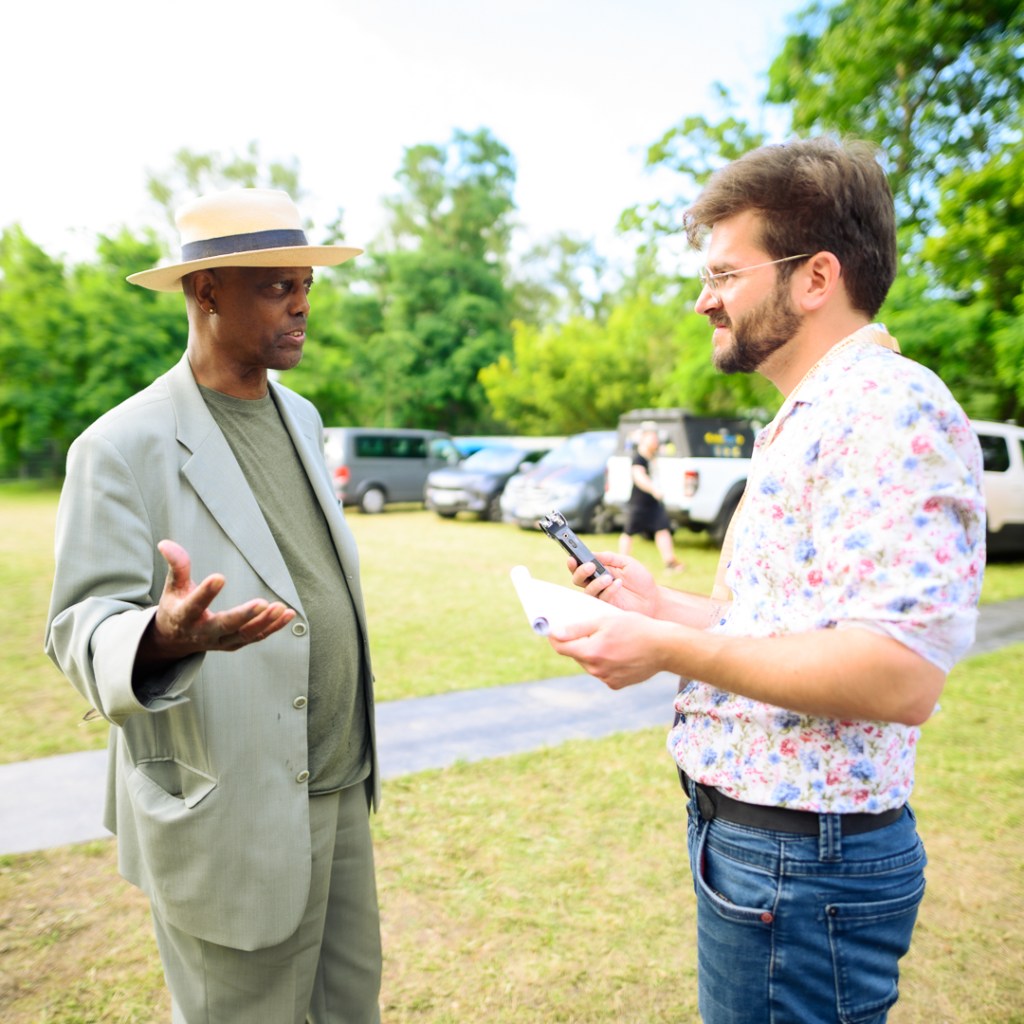
(Der Autor und Eric Bibb im Interview, Foto: Shi.Fauzia)
Richard Limbert (Key West):
First of all, thank you for the great concert. I was just taken away by it. It was amazing and when I listen to you, I hear you are crossing musical borders left and right. I hear Blues, I hear Folk, I hear Country Music, I hear so much. And you also grew up in this immensely musical household. So did genre ever did play a part in your life?
Eric Bibb:
No. At the time, what we call Folk Music included everything, from Blues to Calypso, to west African drumming to Celtic Irish music and Scottish music. It was a very democratic world, this music world.
This compartmentalizing of music is, I think, obviously perhaps necessary for marketing purposes. But I think it limits musicians and I’ve always tried to break free from Blues prison and from whatever box people want to put you in. But the truth is, all of these musical genres are related, they are all cousins, you know? I grew up with a very eclectic musical diet, so I guess all of these influences you can hear in what I do.
Richard Limbert (Key West):
How was it, meeting so many talented musicians in your childhood? I mean, Bob Dylan, Joan Baez, all of these people walked in and out basically….
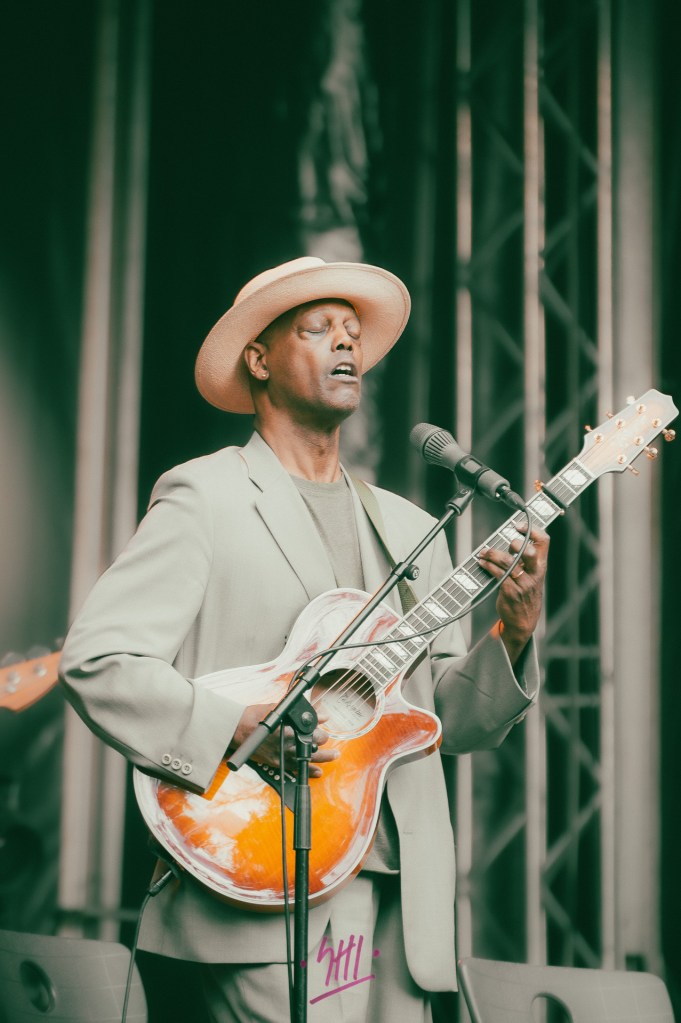
(Eric Bibb bei seinem Konzert auf dem Rudolstadt Festival im Juli 2024, Foto: Shi.Fauzia)
Eric Bibb:
… and Odetta, Pete Seeger, Richie Havens, Taj. All of these people. It was amazing. I’ll tell you, when I look back I think about a childhood that was like a dream. Up close I met all of these people in my own room sometimes. Including Dylan. So, you know, for me, doing what I’m doing, it doesn’t get better than that. I’ve been prepared that way.
Richard Limbert (Key West):
I can imagine, yeah. I am also a songwriter and write my own stuff. And this is a question I always ask songwriters at a certain age: What advice would you give to young songwriters nowadays?
Eric Bibb:
I think, the idea is to discover the songs and the writers that you enjoy and then, without straining too hard, try to figure out what it is about them that you like. And finding what in your own experience relates to that. I think, the important thing is to be as authentic as you can. Meaning that it has to resonate with you, it has to mean something to you personally. It can’t just be a decision based on ‚Oh, I think that would be hip‘. It has to emotionally touch you.
Richard Limbert (Key West):
And do you think that’s harder nowadays than in the 70s, because of the internet and all of that?
Eric Bibb:
That’s a good question. It think it’s wonderful that young musicians and writers have access to so much. But maybe it can be too much. Maybe you get distracted by the amount of information out there. I remember, you know, when I was growing up you had to go to the record store. You had to buy. You had to buy the record. You had to pay your own money. And you had to find out what tracks on the album really work for you, which ones you love the most. Now it’s just so easy. You go to any of these platforms. But on the other hand, we had a hard time finding rare recordings. Particularly of the early Blues guys. Now you can find all of that stuff. And that’s great! I am so happy that it is not going to be lost. That there are young people who are going to be able to find out not only about Robert Johnson, but people who were around him who were much lesser known. So that’s a blessing.
Richard Limbert (Key West):
Yes. I have a super long Spotify playlist with people I would have never heard of otherwise.
Eric Bibb:
Have you heard of Garfield Akers?
Richard Limbert (Key West):
No
Eric Bibb:
Okay, I want you to remember this name: Garfield Akers. He only recorded four songs, in Memphis, in 1932 or something. There is this song called Dough Roller Blues. It’s so groovy, it’s so wonderful and I’m sure Robert Johnson heard him. Because I can hear some kind of influence. So, yeah, listen to Garfield Akers.
Richard Limbert (Key West):
Great, thanks for the advice! So, I wrote my Bachelor’s Thesis about Dave van Ronk. I am a musicologist and I wanted to write something about Bob Dylan’s and Dave van Ronks‘ relationship in the early 60s. But in this whole process I became more and more interested in the 1980s Greenwich Village Folk scene, which I think you were also a part of.
(Hier der Dough Roller Blues von Garfield Akers):
Eric Bibb:
Yes. I was in New York during the 80s, around Folk City. There were people around like Eric Frandsen, and Dave van Ronk was somebody I knew from before. I did gigs with him. In a place called The Knitting Factory I did a gig with him, I remember. And I also did a gig with Dave in a place in Boston called Passim, a club. Dave was a great guy, a wonderful musician and thinker. A great cook as well! But Dave had a lot to do with the richness of that early 60s scene. A course everybody took from him, including Mr. Dylan. Did you see the Dave van Ronk movie?
Richard Limbert (Key West):
I think it was an interesting take. It was more like inspired by some things in his life.
Eric Bibb:
Yeah, I thought it was an interesting film.
Richard Limbert (Key West):
You also met Dylan when he was pretty young.
Eric Bibb:
He was twice my age, I was eleven. He was 22. He’d recently come to New York, he was the talk of the town. My dad had a party and invited a lot of showbiz people, like Peter, Paul & Mary. And Dylan finally showed up at around 12 midnight. I came down in my pajamas and I met him. I said ‚Hey, man. I play guitar, too‘, and we talked and he said ‚You know, keep it simple, forget all the fancy stuff.‘. That’s what he told me.
Richard Limbert (Key West):
And that’s what you still do!
Eric Bibb:
Well, I wish I could thank him for his advice and for taking the time to speak to an 11-year old. If I met him today, I’d say ‚Man, I’ve got so much PR-mileage out of that conversation we had years ago.‘.
Richard Limbert (Key West):
What’s your favorite album by Dylan or your favorite period?
Eric Bibb:
Oh, that’s a great question. [thinks a bit] I love Freewheelin‘, I love The Times, They Are A-Changing, I love Tangled Up in Blue. I like John Wesley Harding, too a lot. It was a shock for people, but I also did like Nashville Skyline.
Richard Limbert (Key West):
Also, sometimes, when I listen to Oh, Mercy I get reminded of your style.
Eric Bibb:
Yes, yes. That it a good record, too. I haven’t heard too much of it but I know what you mean.
Richard Limbert (Key West):
The first time I listened to it, it was night and it was the perfect time.
Eric Bibb:
I’d have to go over and revisit that.
Richard Limbert (Key West):
At night!
So what do you think about the current Folk scene in Greenwich Village?
Eric Bibb:
I’m not familiar with enough of it to really comment on it. But I am sure that there are wonderfully talented young people who are going to carry it further. I think there are probably some really good writers out there. I can’t think of somebody who I want to mention right now but I’m sure that there is going to be some wonderful Joni Mitchells coming up. I saw Joni Mitchell when I was like, this was 1968 or 69 in a club. Just six feet away from her. Just her and her guitar, Jerry Jeff Walker, those kind of people.
Richard Limbert (Key West):
I don’t want to end this with too dark of a note, but what are your thought on the upcoming elections in the USA?
Eric Bibb:
I am seriously worried about my country of birth. I see more craziness than ever before. More ignorance, more hatred. And I don’t know what to say. I don’t think it’s going to get better soon I think it’s going to get worse. But sooner or later, because there are always going to be people who are engaged in trying to make thing better for everybody there will be change. I am reading a great book which I will recommend to you. It won a Pulitzer Prize. It’s called His Name is George Floyd [von Robert Samuels und Toluse Olorunnipa]. It’s a brilliant book, not only because it tells George Floyd’s story, but it examines his family history all the way back to slavery. So you get an overview of America’s brutal history regarding racism. So, when I read that book, I realized that there are young people, not just African-American but young people in general who are waking up. And who are more aware. And I’m hoping that those young voices will eventually not only be heard, but they will actually take over. I don’t know how long it’s going to take. I worry about the next period. I do.
Richard Limbert (Key West):
I think I understand. Thank you so much for talking with me. It was so nice meeting you.
Eric Bibb:
Thank you! The same.
Hier sein Konzert auf Deutschlandfunk zum Nachhören:
https://www.deutschlandfunkkultur.de/rudolstadt-festival-konzert-von-eric-bibb-aus-den-usa-dlf-kultur-e100a8dc-100.html
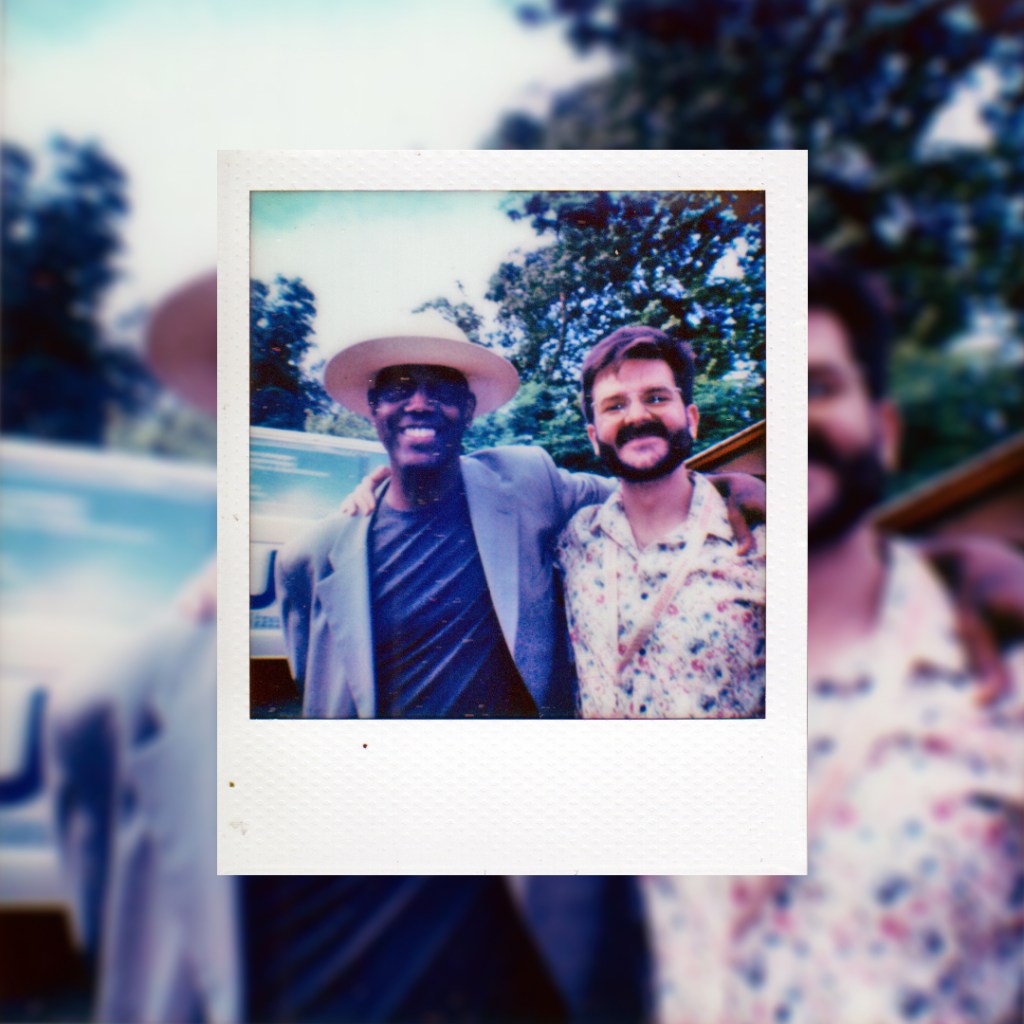
(Polaroid-Foto von Richard Limbert und Eric Bibb, Foto: Shi.Fauiza)
 Key West
[…] Ein Interview mit Eric Bibb […]
LikeLike
Vielen Dank für das tolle Gespräch an dem ihr uns habt teilhaben lassen! Super Fragen und einfach cool (und aufrichtig) wie Mr Bibb auch meint, dass er nicht nah genug dran ist um zu sagen, was gerade im Villlage los ist!
LikeGefällt 1 Person
Lieber Till, danke sehr für deinen Kommentar. Ja, ich habe ihn im Interview auch als sehr nahbar und ehrlich wahrgenommen. Es war ein echt spannendes Gespräch mit einem intelligenten und sympathischen Musiker. Es lohnt sich, bei Eric Bibb tiefer einzutauchen.
LikeLike